
Walk a Marion Street Record
A Marion street directory search works best as a chain. Ownership comes from the Linn County Assessor and Recorder. A voter match can confirm one registered person when the searcher already has the required personal details. Reverse directories show listed households at a past date. None of those sources alone proves every person who occupied a home.
Keep the house number, street spelling, search date, GPN, and legal description with every result. The GPN is the county parcel key. It lets a search survive small differences between a postal address, a permit service address, and the wording in a deed.
- Enter the house number and street name in the Linn County Assessor residential search. Do not add the city or ZIP.
- Open the parcel card, record the GPN and legal description, then follow the map link to view nearby parcels.
- Use the recorder book, page, or instrument link to locate the deed. A deed names parties to title, not all occupants.
- Check the Iowa voter lookup only for a known person when the required name, birth fields, ZIP, and house number are available.
- For an earlier household, search Marion's reverse directory by address and corroborate the listing with a newspaper or census record.
This method separates a current property owner from a listed resident. If the task expands from one block to a historical household, the Marion city directory collections explain the scanned annual and reverse volumes.
Marion Street Search Fields
The assessor form is free and requires no login after its disclaimer is accepted. It does not expose an owner-name box. That design makes an address, parcel number, or land description the sound starting point for a Marion street directory search.
| Field | Input | Useful detail |
|---|---|---|
| All Parcels / Photos Only | Radio choice | All parcels is the default. |
| Parcel Number | Text | The percent sign works as a wildcard. |
| House Number and Street Name | Text and autocomplete | Leave out city and ZIP; county street names are checked by default. |
| Description | Partial text | Useful for a lot, block, or subdivision phrase. |
| Section, Township, Range | Three text fields | Supports rural land descriptions. |
| Lot Area | Minimum and maximum acres | Default range is 0 through 209 acres. |
The live assessor form shows these controls and the county disclaimer.
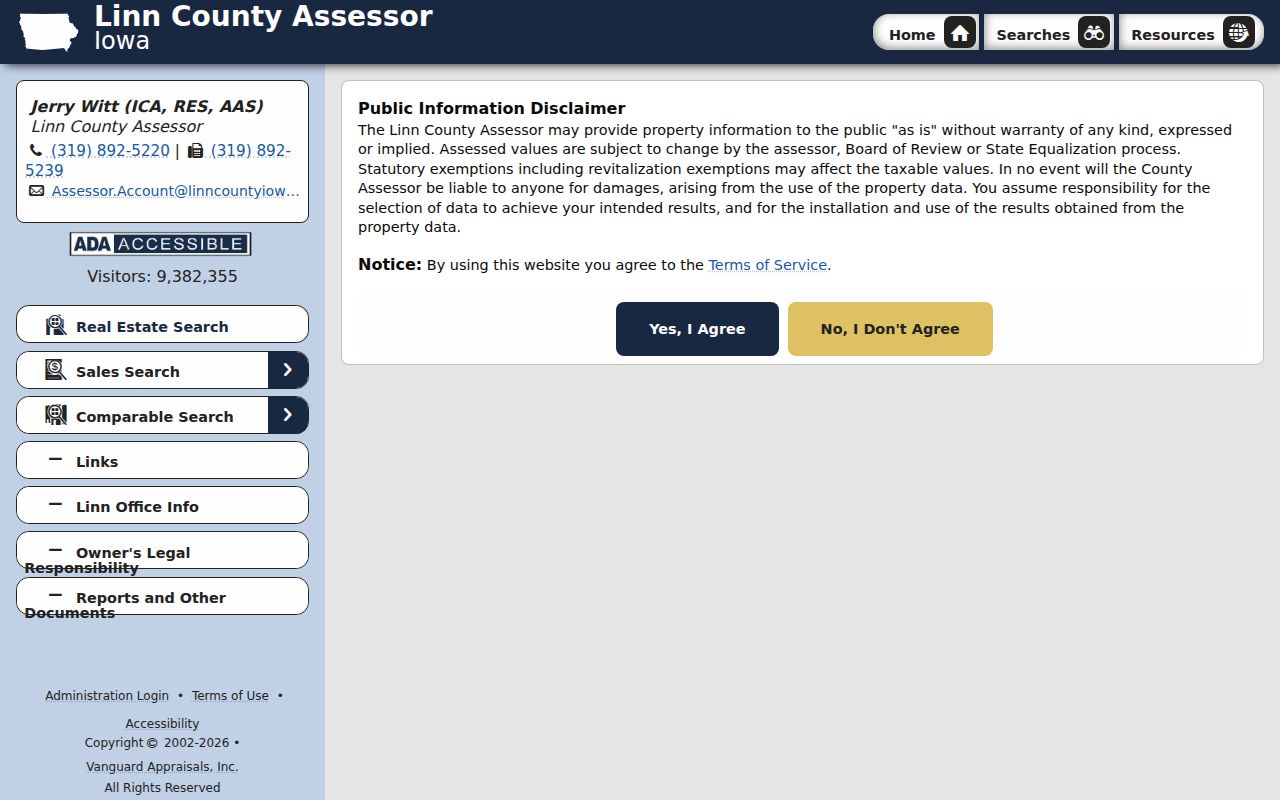
Choose View Results, then read the result card rather than treating the search form as the record. Current ownership, mailing context, assessed values, exemptions, and links can change after the page is indexed.
Map Marion Parcels by Street
The Linn Land Records Map turns one address into a block view. Pan, zoom, and select each parcel. Layers include parcels, subdivisions, corporate limits, zoning, flood areas, boundaries, easements, contours, wetlands, and GPN labels. There is no verified named radius tool, so use visible parcel geometry rather than promising an automated buffer.
The official parcel service exposes situs city and ZIP, legal description, deed and contract owner fields, tax districts, acreage, assessment fields, and recorder book, page, and instrument data. That makes the map the main bridge between a street and recorded title.
The official GIS parcel layer shows the field structure behind that workflow.
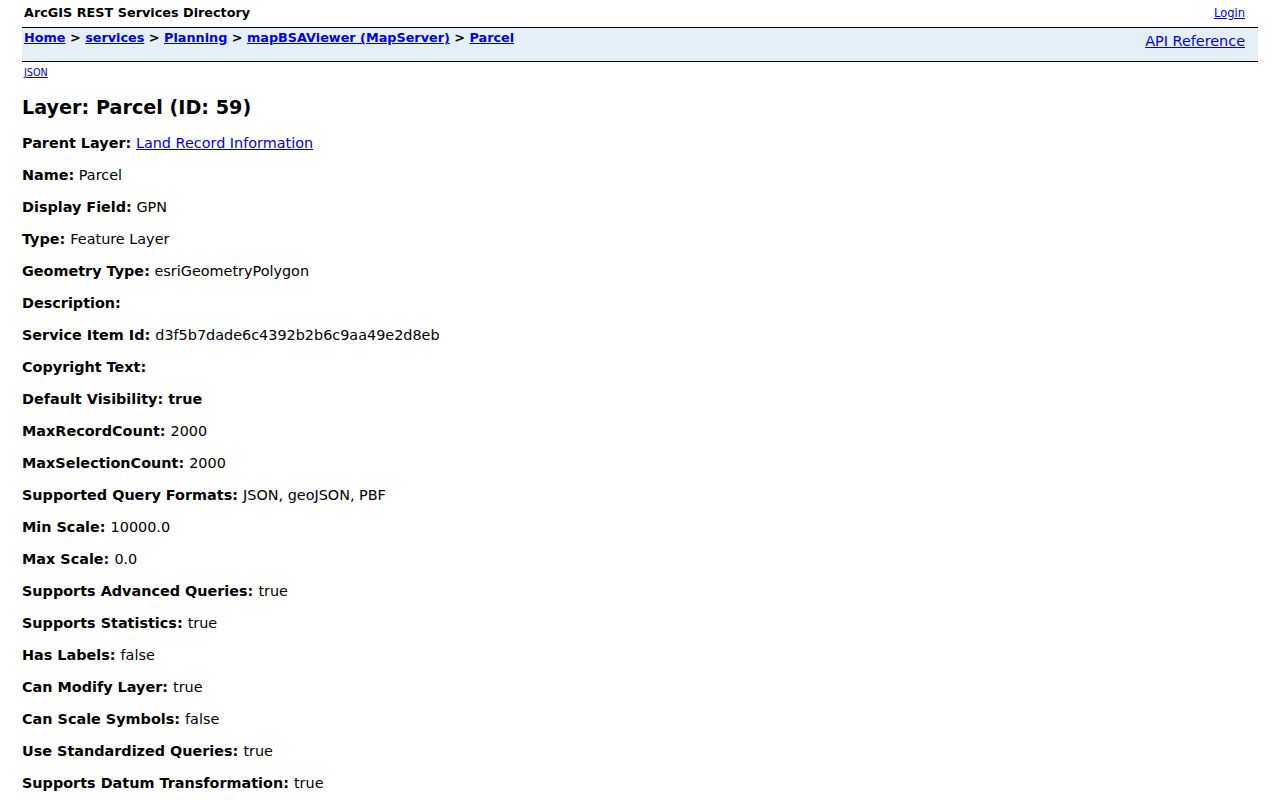
The captured layer confirms that GPN, situs, legal, tax, and recorder links can be reviewed without turning the map into a household roster.
Marion Records Keyed by Address
Several custodians hold parts of the Marion by-street trail. The parcel key and exact service address keep the sources aligned, while the date tells the reader which era each claim describes.
| Address source | Keeper | What it can establish | Access route |
|---|---|---|---|
| Assessor card | Linn County Assessor | Owner labels, situs, mailing context, legal description, tax class | Free web form; office help |
| GIS parcel | Linn County GIS | GPN, geometry, districts, legal and recorder links | Free map and REST layer |
| Recorded instruments | Linn County Recorder | Grantor, grantee, document type, recording data | AVA, phone, mail, drop box, or counter |
| City permits | Marion Building Services | Service address, permit number and type, project context | Public portal from 2010; office for older files |
| Voter record | Iowa SOS and Linn Election Services | A match for one registered voter with required inputs | Individual lookup; regulated list request |
| Reverse directory | Marion digital archive | Listed occupant or subscriber at an address in an edition | Free scanned collection |
The sequence matters. Property records identify title, permits document work, voter data concerns registration, and a reverse listing is a dated publication. Calling all four facts “who lives here” would overstate the evidence.
Marion Address Terms Decoded
Four terms prevent common mistakes in a street-by-street search. Preserve the label used by the custodian instead of replacing it with a broad claim about residence.
- Parcel
- A mapped piece of land identified by a county GPN.
- Situs address
- The physical location tied to a parcel, which can differ from the owner's mailing address.
- Plat
- A recorded map that connects lots, blocks, subdivisions, and streets.
- Criss-cross directory
- A directory arranged by street and house number rather than only by surname.
Marion also has postal, municipal, and legal keys. ZIP geography does not set city limits. A legal description may omit the street number entirely, while an owner notice may go to another town or a post office box.
Follow Marion Deeds Along Blocks
The Linn County Recorder's real-estate holdings reach transactions from the 1850s, but the start date for online AVA images was not verified. Begin with the recorder link on the current parcel. Note the grantor, the person or entity transferring an interest, and the grantee, the recipient. Also copy the document type, date, legal description, and instrument or book and page.
To step backward, search the present seller as an earlier grantee at the same legal description. A mortgage, release, lien, or assignment is not a sale. When the description changes, use the recorded plat or prior instrument as the bridge. AVA did not expose its controls during research, so older or difficult searches should go to the Recorder by phone, mail, drop box, or at the counter. The office is open Monday through Friday, 7:30 a.m. to 4:30 p.m.
Bring enough detail for staff to locate an existing record: the GPN, legal description, approximate date, document type, grantor or grantee, and any known book, page, or instrument number. Ask whether the needed image is online, available for inspection, or must be copied. County fees list plain copies at $1 per page and certification at $5, while recording charges follow a separate schedule. Confirm the cost before ordering. A certified copy proves what was recorded; it still does not set a move-in or move-out date.
Marion Permits by Service Address
Marion Building Services provides a second address timeline. Its public Tyler search covers 2010 to the present and exposes Permit Type, Permit Number, and Service Address. The city says its building work can span plan review, structural and accessibility work, energy, electrical, mechanical, plumbing, zoning, drainage, inspections, and final approval.
Open the Marion permit search to check the current interface.
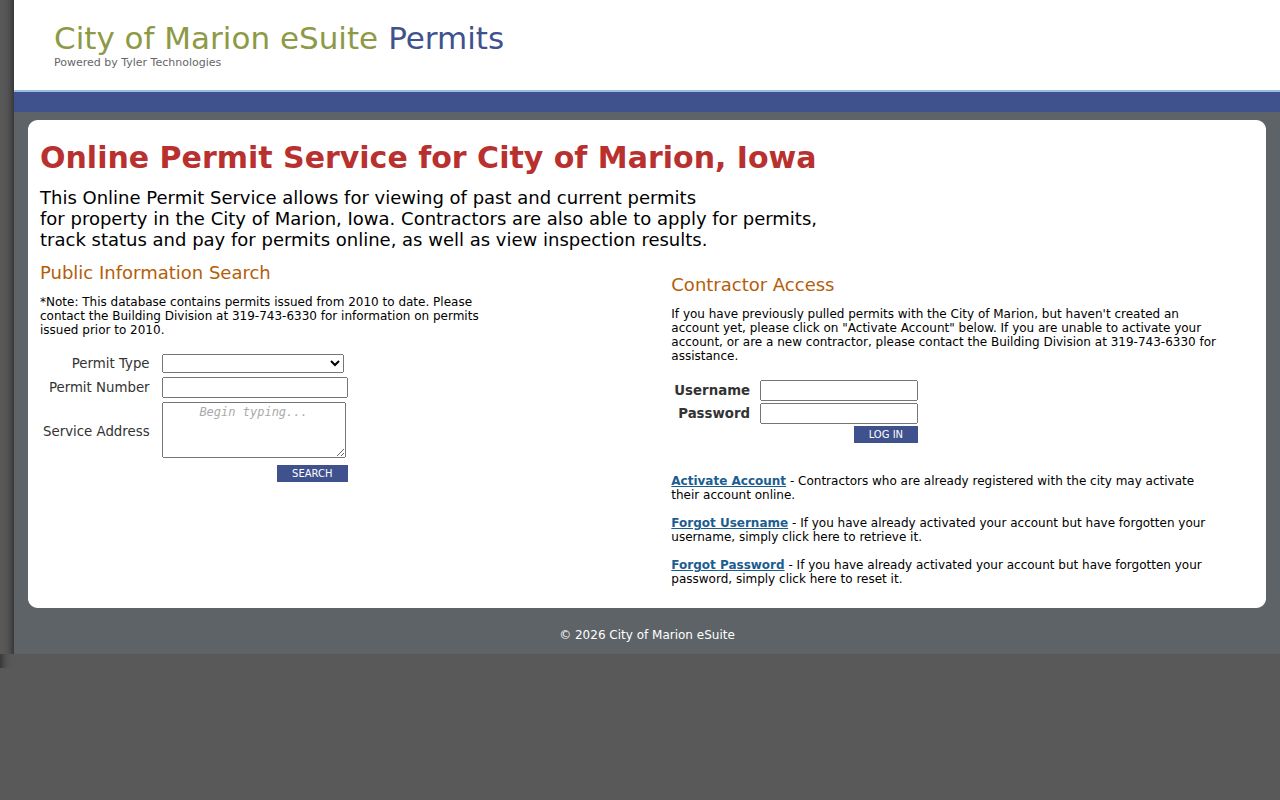
The captured form supports address-based searching. A permit applicant or contractor is context for work at the site, not proof of occupancy. Call Building Services at 319-743-6330 for pre-2010 permits. Code cases lack a public index, so request an existing file by address and date range.
Older Marion Streets in Print
Marion's Digital Community History Archive carries the Marion City Directory from 1915 through 2009, a telephone directory run from 1927 through 1937, and a rural directory labeled 1900 through 1947. The 1996 volume includes a street guide or reverse section. Enter an old address in the archive, then inspect nearby pages because optical character recognition can miss small type and abbreviations.
Current GIS, a 1996 reverse directory, and a federal census answer different questions. Stack them by date. Do not merge them into one timeless resident list. Exact annexation, street-renaming, and renumbering chronologies were not found, so an address that disappears should be checked against city maps, plats, newspapers, and legal descriptions before it is treated as a move.
The official 2022 Marion community map shows the city's grid, key roads, parks, schools, and cemeteries. It aids orientation, but it is not a legal address standard. The April 2026 zoning map is current for planning context yet cannot search by parcel or address. For a disputed or new address, contact Marion Planning or Engineering and Linn County GIS with the parcel, subdivision, and date instead of relying on a printed directory label.
Marion Voters Are Not Rosters
Iowa's “Am I Registered?” form checks one voter. It requires first and last name, ZIP, house number, birth month and day, and birth year. It does not publish a browsable Marion street directory. Linn County voter-list requests are separate and governed by Iowa Code sections 48A.38 and 48A.39, including purpose restrictions and nonpublic fields.
Safe at Home can substitute a confidential address for qualifying survivors. Driver records and utility customer names are not public street-list sources. If registration data is needed, use the Secretary of State lookup or contact Linn Election Services through its official request process.
Limits of Marion Street Directories
A parcel card can identify a deed or contract owner, not every person inside a home. A mailing address can belong to an owner, trustee, company, or fiduciary elsewhere. Permits name people connected with a project. Voter records cover registered voters and omit protected fields. Older directories list subscribers or householders according to the rules and timing of one edition.
Utility accounts, driver addresses, private organization rosters, and a custom citywide resident list are not substitutes. Iowa Chapter 22 provides access to existing public records, but a custodian need not create a new list that does not exist.
Use address records lawfully. Marion records support personal research and civic curiosity; never use them to stalk, harass, intimidate, or harm anyone.