
Marion Directory Runs and Access
The Digital Community History Archive is the clearest verified inventory. It provides free search and page browsing. Its date labels are finding aids, so inspect the scan before assuming that every year is present or that every volume shares one publisher.
| Collection | Years | Where held | Access |
|---|---|---|---|
| Marion City Directory | 1915-2009 | Digital Community History Archive | Free search and scans; 26,908 pages |
| Marion City Directory V2 | 1928 | Digital archive | Free scans; verify title against page image |
| Marion Directories V2 | 1935 | Digital archive | Free scans |
| Marion Telephone Directory | 1927-1937 | Digital archive | Free scans; phone and address clues |
| Marion Rural Directory | 1900-1947 | Digital archive | Free scans; rural household clues |
| Polk anniversary edition | 1996 | Digital archive | Resident, business, street/reverse, and classified sections |
The earliest verified main run starts in 1915, and 2009 is the last digitized year. No official source established a later printed issue. The 1996 scan says R.L. Polk had published that edition series since 1958, but that statement should not be extended to every volume in the archive.
Inside Marion's 1996 Directory
The anniversary edition gives an unusually clear snapshot of its own scale. Page 7 reports 11,595 total listings: 7,446 household listings, 3,298 resident listings, and 851 business listings. It also reports 2,662 new or updated listings. These counts describe that edition, not Marion's total population.
Open the 1996 Marion City Directory result and move through the page images.
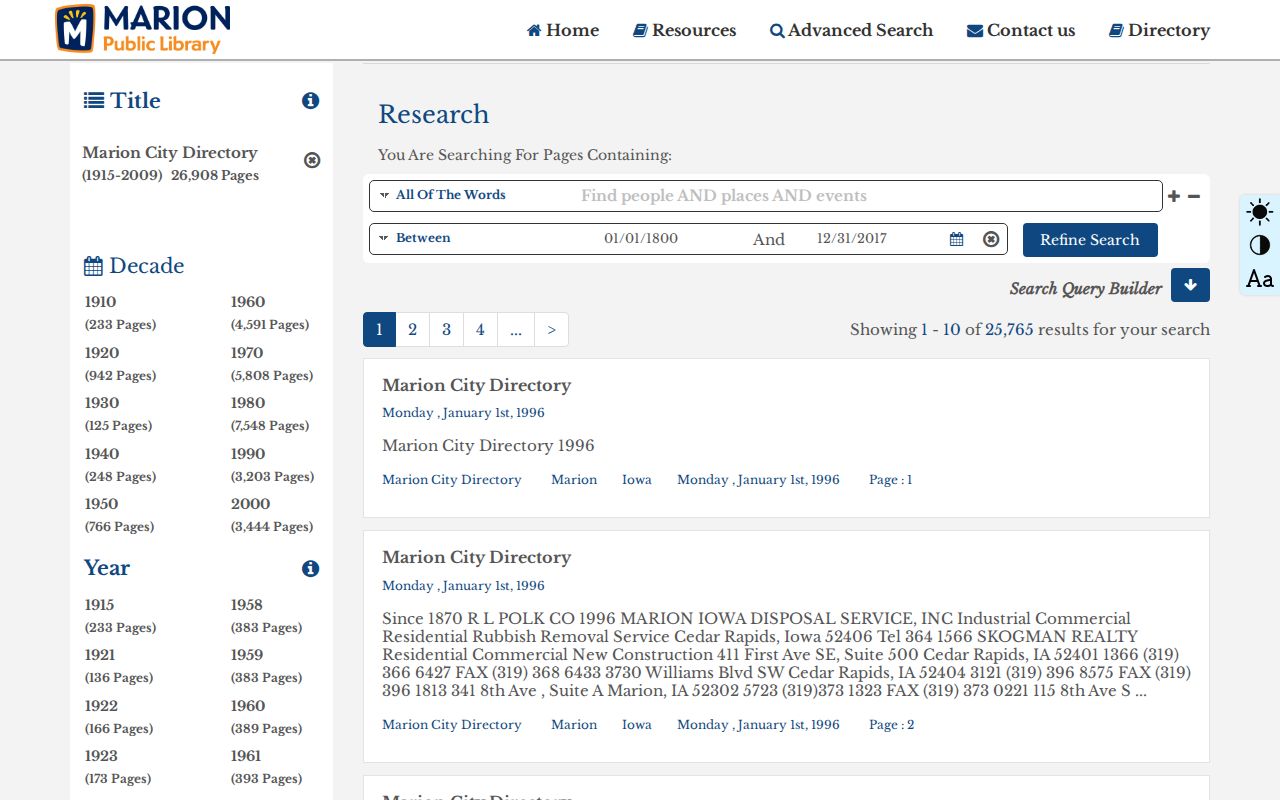
The captured archive view is useful for confirming the issue date and browsing adjacent pages when text recognition misses a short name or small abbreviation.
Read a Marion Directory Entry
Page 9 describes four sections in one book: an alphabetical resident section, business and professional listings, a street guide or reverse section, and classified listings. A resident line may connect a name with a spouse or household note, address, telephone, occupation, and a homeowner indicator. Read the edition's key before expanding a short form.
| Name | The alphabetic access point; compare initials and variants. |
|---|---|
| Spouse or household note | A relationship clue as printed in that edition. |
| Address | The listed house number and street at publication time. |
| Telephone | A subscriber clue, not proof that every household member appears. |
| Occupation | Work or trade wording printed in the entry; use it as a historical search term. |
| Homeowner mark | An edition-specific symbol that must be checked against its key. |
One sample page moves from an Adams Bakery manager listing into resident entries and an alphabetic surname transition. That mix shows why the section heading and nearby lines matter. A business connection should not be mistaken for a home address.
- Criss-cross directory
- A street-order section that moves from an address to a listed occupant or subscriber.
- Householder index
- An index centered on household listings rather than a complete count of all people.
- Abbreviation key
- The edition's own list of shortened words and marks, which controls how entries should be read.
Reverse Marion City Directories
The street guide changes the question from “Where did this person live?” to “Who was listed at this address?” In the 1996 Marion city directory, use the street name, move to the house number, and inspect nearby addresses. That makes the section valuable for a block, a prior owner, or a neighbor remembered only by location.
A reverse listing is still a dated publication. Compare it with the deed holder and with the closest census or newspaper item. For present parcel work, switch to the Marion by-street records workflow, which keeps ownership and occupancy labels separate.
Marion Telephone Directory Sources
The 1927-1937 Marion Telephone Directory supplies subscriber and address clues between main directory editions. A missing person may have lacked a telephone, used another household's line, or been omitted. Search adjacent years and surname variants before drawing a conclusion.
The Marion Rural Directory, labeled 1900-1947, helps where township, route, farm, or rural geography does not match a modern street. Pair its words with the legal land description, census township, plats, and newspapers. Marion's boundary changed over time, and the research did not locate a complete official annexation or renaming chronology.
Marion Library Research Channels
Marion Public Library is the principal walk-in starting point at 1101 6th Avenue, phone 319-377-3412. Hours are Monday through Thursday, 9 a.m. to 8 p.m.; Friday and Saturday, 9 a.m. to 5 p.m.; and Sunday, 1 to 5 p.m. Ask reference staff about print holdings because no official shelf inventory for every city directory was found.
The library's online resources include the Digital Archives, Ancestry Library Edition in the building, HeritageQuest, Fold3, Chronicling America, Iowa Heritage Digital Collections, America’s News/Gazette, and the Linn County Obituary Index. Licensed access can depend on a library card, Marion residency, or use inside the building.

The captured library list shows which tools are direct web resources and which may require a card or an in-building session.
Marion Directory Research Appointments
The Pat Klopfenstein Library at the Marion Heritage Center holds newspapers, books, maps, photographs, artifacts, and local-history material. Staff and volunteers offer genealogy and photo searches by appointment. Materials do not check out. Access is free for Marion Historical Society members and donation-supported for others; listed copy charges are 10 cents for black-and-white and 50 cents for color.
Review the Heritage Center resources before arranging a visit.

The captured resource page confirms an appointment route when a directory scan needs support from photographs, maps, or local family files.
Marion Directory Timeline
The historical sequence helps choose the nearest available source without inventing a missing annual volume.
| Date | Marion record milestone |
|---|---|
| 1866 | Marion Register newspaper run begins in the archive. |
| 1900 | Starting label for the rural directory collection. |
| 1915 | Earliest verified Marion City Directory year. |
| 1927 | Telephone directory run begins. |
| 1958 | The 1996 Polk edition says its publication series began. |
| 2009 | Last digitized year in the main directory title. |
Marion's railroad arrived in 1864 and the city became a division point in 1887. Railroad terms, company names, and route language can therefore sharpen newspaper and early business searches even where no employee roster survives.
Marion Directory Shelf After 2020
The August 10, 2020 derecho damaged the Marion Public Library, and the library history says about 20 percent of its collection was lost. The new 6th Avenue building opened November 10, 2022. That event can explain why a physical local-history item is no longer on a shelf.
Use parallel channels when staff cannot locate an item: the digitized archive, the Heritage Center, the State Historical Society of Iowa, and Linn County genealogy collections. The storm did not erase the entire city directory run, and it should not be turned into a claim about any specific missing volume.
Trace Marion Directory Families
City directories fill years between federal census releases. Iowa also took a final state census in 1925, and federal census schedules follow the 72-year release rule. Choose records closest in date, then compare names, ages, relationships, and addresses without forcing them into one identity.
- Find the first strong surname match in a Marion directory and save the page, edition, and abbreviation key.
- Move forward and backward through nearby editions, noting address, spouse, telephone, and occupation changes.
- Check the reverse section for the same address and nearby listed households.
- Pair the trail with an available census year, keeping ward, township, and city-boundary differences in view.
- Use the Marion newspaper runs, obituary index, Oak Shade records, or probate files to test a disappearance or death clue.
A missing entry can mean a move, death, changed surname, unlisted phone, publication gap, or recognition error. It is not proof by itself. Keep each Marion city directory citation tied to its own year and page.
Newspapers can explain the change. The digitized Marion Register spans 1866-1920, the Marion Sentinel spans 1890-1988, and the Marion Times spans 1992-2021. Search the address, surname, spouse, trade, and nearby organization names. America’s News/Gazette adds 1992-present access for eligible Marion library users. The Linn County Obituary Index covers roughly the 1930s through the 1980s as a finding aid, not as a certified death record.
The Linn County Obituary Index provides the historical finding-aid route.
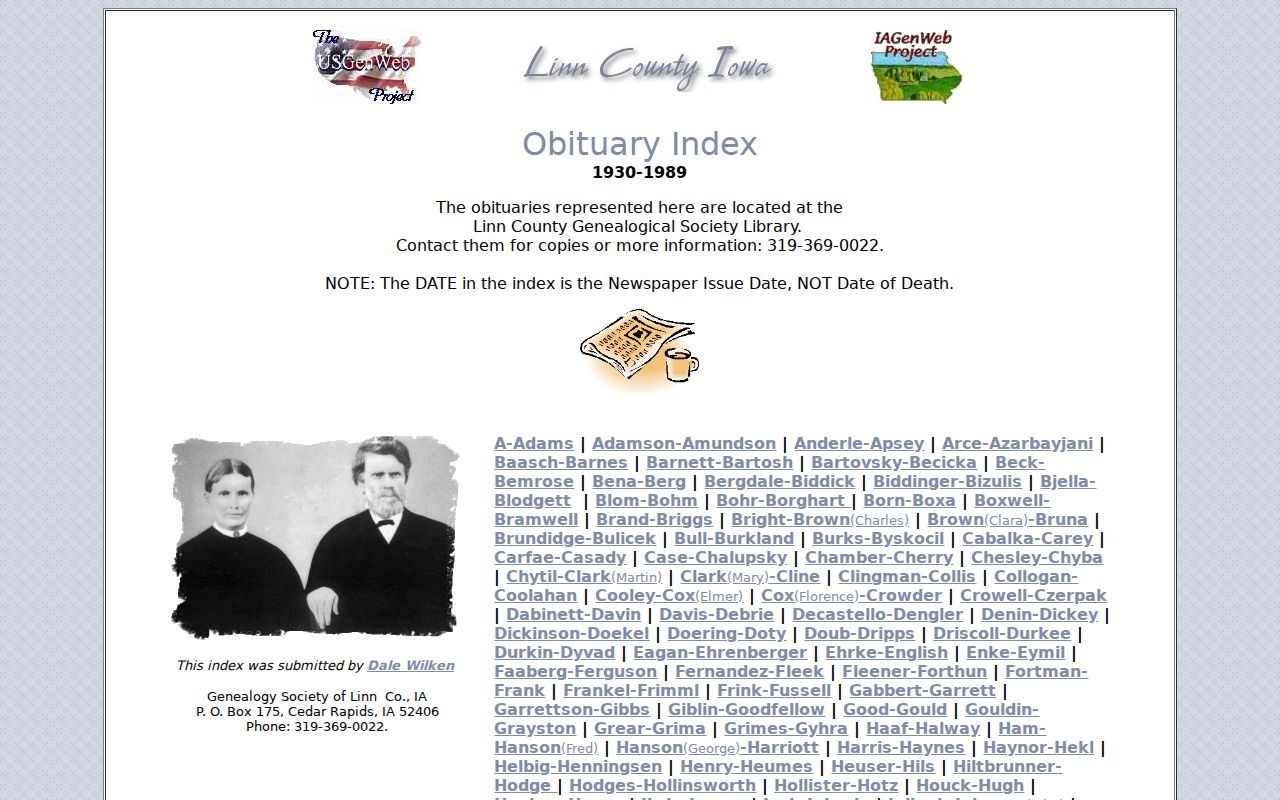
The index can point to an obituary with relatives, service, and cemetery details, but each notice remains a secondary source that may contain errors.
Beyond Marion City Directories
The State Historical Society's Linn County record groups extend the search to land, lot, court, probate, naturalization, cemetery, and vital series, with some county material beginning in the 1840s and 1850s.
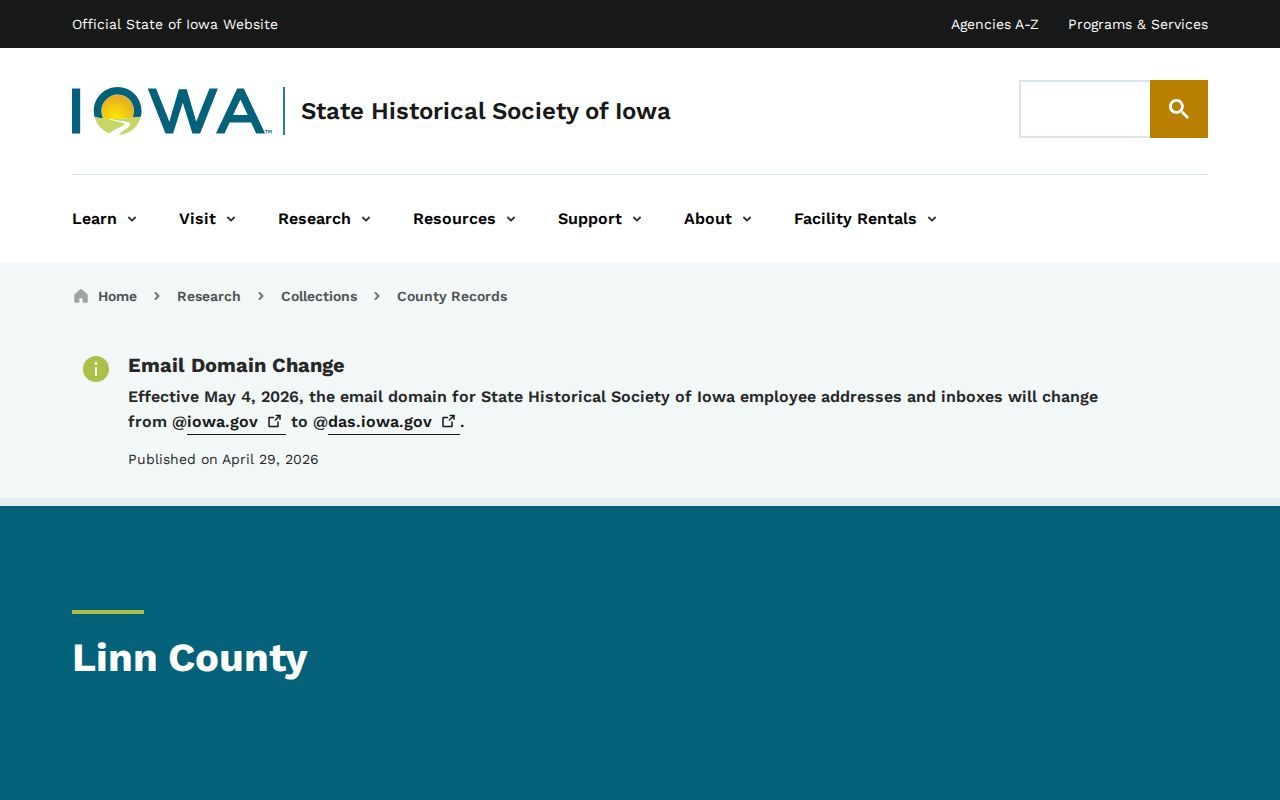
The holdings page provides a custodian and date range when a city directory clue points to a deed, estate, marriage, court matter, or cemetery record. Church, school, funeral, and private group records require a collection-specific inquiry; no complete public roster was verified.